Sunday, August 21, 2011


Shell-shocked investors flee to safe havens

By: 


 0share7 7
NEW YORK—Fears of a new recession have wiped trillions of dollars in value from global stock markets in recent weeks and sent investors scurrying to assets they view as less risky.
But are “safe havens” like gold really safe? Here are several of the refuges where panicky investors have been shifting their portfolios amid the market turmoil, and the pluses and minuses of each:
GOLD: The price of gold, a time-honored store of value, skyrocketed to a new record of $1,878.15 per ounce on Friday, and some analysts say it could go above $2,500 this year.
The World Gold Council, an industry body, predicts that strong demand in India and China will continue to prop up the gold market this year.
“A developed world with slower growth, a large fiscal deficit and near zero rates over the next few years, inflationary pressures in emerging economies, and larger political and economic uncertainty bodes well for history’s oldest form of wealth,” Barclays Capital said.
Skeptics argue that gold has little inherent value and is vulnerable to sudden drops in price. In the two decades before 2003, its price was essentially flat, mostly hovering between $300 and $400 per ounce.
U.S. TREASURIES: US government debt has long been seen as “risk-free,” and paradoxically this has remained the case even after Standard & Poor’s downgraded the United States this month.
Prices have surged in recent weeks, as spooked investors bought Treasury debt on which yields had fallen virtually to zero percent, or a loss if measured against inflation.
The 10-year bond dropped to a record low of 1.974 percent on Thursday, before pushing back just above the 2.0 percent line.
“It wouldn’t shock us to see another quick sharp move and then staying under two percent especially if the eurozone issues worsen,” said George Goncalves, head of US rates strategy at Nomura.
But he cautioned that the bond rally might lose steam: “We believe that the majority of bond market gains are behind us,” Goncalves said.
SWISS FRANCS: Switzerland’s currency has proved a popular safe haven for those who fear their dollars or euros will fall due to stagnant growth or possibly inflation.
Over the past year, the Swiss franc has gained more than 30 percent against the dollar and over 16 percent against the euro.
However, this month Switzerland’s central bank began intervening to halt the rise of the currency, tarnishing its appeal as a safe haven.
JAPANESE YEN: Japan’s currency hit a post-World War II record of 75.95 yen against the dollar on Friday, even though Japan has vowed to contain the rise of the yen to protect its vital export sector.
“There is no reason that the yen should be regarded as a flight-to-safety currency,” Takehiko Nakao, Japan’s vice finance minister for international affairs, told Dow Jones Newswires on Friday.
THE VIX: When markets are fearful, one of the best investments may be to buy fear itself – contracts tied to the Chicago Board Options Exchange Market Volatility Index, better known as the VIX.
Often called the “fear gauge,” the VIX is a measure of the volatility of the S&P 500 stock market index and tends to spike when investors think a crash is imminent. It jumped 35 percent during Thursday’s big sell-off.
Not a safe haven in the traditional sense, sophisticated investors use VIX derivative contracts to protect themselves from volatility.
Trading in VIX-related contracts “exploded in volume” in the past two weeks, said Adam Warner, an options analyst with Schaeffer’s Investment Research.
US FARMLAND: Some say the most reliable way to hedge against catastrophe can be to buy US farmland, which has surged in value this year as food prices have soared and bad weather has tightened the global food supply.
The value of farm acreage in the five US midwest farm states grew 17 percent in the second quarter of 2011, its largest year-on-year increase since the 1970s, according to the Federal Reserve Bank of Chicago.
“Since the financial crisis, we’ve seen investor interest rise every year,” Stephen Johnston, chief investment officer for Agcapita, a Canadian farmland investment fund, told AFP.

Monday, August 8, 2011

Philippines to continue buying US treasuries


Debt paper still investment grade, highly liquid

By: 
Philippine Daily Inquirer


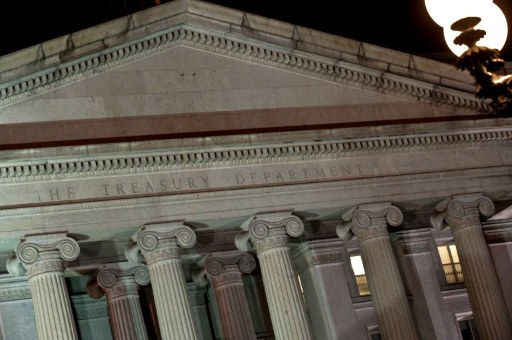
STILL INVESTMENT GRADE The facade of the US Treasury Department is seen on August 5, 2011, after Standard & Poor's cut the US credit rating from its top-flight triple-A one notch to AA+, and added a negative outlook to it. In reaction to the credit downgrade, the Bangko Sentral ng Pilipinas said a Double-A-plus rating was still investment grade and US treasuries remained to be instruments that the Philippines could invest in. AFP Photo/NICHOLAS KAMM
The Philippines will keep its holdings of US treasuries, which make up the bulk of the country’s foreign exchange reserves, even with the downgrading of the Triple-A credit rating of the United States.
In reaction to the credit downgrade by ratings firm Standard & Poor’s, the Bangko Sentral ng Pilipinas said a Double-A-plus rating was still investment grade and US treasuries remained to be instruments that the Philippines could invest in.
The BSP puts the bulk of its $69 billion worth of foreign exchange reserves in US treasuries. Under the investment guidelines of the BSP, the foreign exchange reserves should be invested only in investment grade and highly liquid instruments.
“For the BSP, US treasuries will continue to be within the allowable investible universe for our reserves even with the one-notch downgrade by S&P,” BSP Governor Amando Tetangco Jr. told reporters.
Tetangco said that even with the US credit downgrade, holding on to US treasuries remained prudent since these instruments were still the most liquid and since the value of European assets have been put at risk by the debt woes in the euro zone.
“Because the US market remains the most liquid and deepest and as Europe still faces uncertainty, the US market is not likely going to experience a huge selloff even with the one-notch downgrade. Many still see the US treasury market as a safe haven,” Tetangco said.
Still, the BSP chief said the country has over the years been diversifying its foreign exchange reserves. A small portion of the reserves is invested in other foreign, liquid assets.
“Dips in the value of US treasuries would be compensated for by earlier diversification moves,” Tetangco said.
But although the BSP is poised to continue holding on to US treasuries, Tetangco said it was prudent to pursue actions that would help shield the Philippines from uncertainties in the global economy that might result from the US credit downgrade.
Economists believed that the downgrade of the US credit rating could dampen the outlook on the performance of the global economy and thus drag the overall investment appetite of investors.
Tetangco said the Philippine government’s goal of gradually reducing its budget deficit should help keep confidence of foreign investors in the country’s sovereign bonds.
“It would be good to heed calls for improvements of fiscal management. The call by President Aquino to keep our fiscal house in order is most opportune,” Tetangco said.
Meantime, although the BSP is poised to hold on to US treasuries, Finance Secretary Cesar Purisima said it would be wise to start considering further diversification of the foreign exchange reserves of the Philippines. Purisima added that the same proposal should be considered by policymakers of other countries.
“This development [downgrade of the US credit rating] highlights the need for alternative global reserve currencies and benchmarks that are more stable and as liquid and convertible,” Purisima, who sits in the Monetary Board of the BSP, said in a statement.

Sunday, July 3, 2011

In Philippines, Dutch firm finds perfect factory fit


By: 

Philippine Daily Inquirer


DAVAO City, Philippines—One of the first things that Onno Luitjes and his Filipino wife, Lyndy, noticed when they ordered certain machine parts for fabrication was that the workers in the small shop could not interpret their engineer’s drawings.
But when the couple showed a sample of the stud bolts they wanted, the workers found the job quite easy to do.
The experience made Onno, Dutch president of HGG Profiling Specialist Philippines Inc., and Lyndy realize they can actually trust and rely on Filipino skills when they opened the first overseas branch of the Dutch firm HGG in Davao.
The firm produces parts for its pipe-cutting Computer Numerical Control (CNC) machines for global export.
HGG stands for the initials of the first names of the three owners of a group of companies in Netherlands producing fully automated equipment that have serviced the world’s biggest construction, shipbuilding and offshore industries in the last 25 years, Luitjes says.
“About 87 percent of the parts of these machines are now being produced here,” Gil Dureza, chief of the Board of Investments (BoI) in Southern Mindanao, says.
Since starting its CNC production here in 2008, HGG has shipped out 28 pipe-cutting machines, including equipment that helped build the new airport in Hong Kong and a polo stadium in India.
Made in Davao
“To give you an idea of the technology we are doing in the Netherlands, the pro cutter is the most basic machine the HGG Group is producing,” Luitjes says, referring to the pipe-cutting machine called PC600, which is being produced in Davao.
“The smallest equipment that our company produces in the Netherlands is up to 6.5 meters in height, weighing over 400 tons, which is even bigger than this bodega,” he says of the nondescript warehouse in Bajada.
When HGG opened its Davao branch in 2008, its aim was to explore the growing demand in Asia.
“We are using these products to see the possibilities in the Philippines and to explore the market in Asia,” he says.
Near where he stood looms a yellow machine, the color of which stands out from among the blue ones in the room. He says the machine, which has Chinese markings, would be marketed in China, where people highly preferred bright colors, like yellow.
Closer to customers
By opening up the Davao branch, the company aims to come closer to the customers in terms of the delivery of the new equipment and servicing.
“There used to be a big time gap from Asia and our main factory in the Netherlands,” he says. “We are about seven hours behind but the Davao plant will address this gap because right now, we are operating on the same time zone,” Luitjes says.
HGG targets to service not only China and India from its plant here but also Brazil, the United States, Russia and South Korea.
Luitjes says the most promising Asian markets they’re planning to tap are the oil rig building in Singapore, which would need a lot of piping, the robot lines and angle bar cuttings in China, where the demand will surge because of the bullish shipyard construction in that part of Asia.
“Everywhere, where there are steel structures being produced, there will always be a demand for our machine,” he says.
To cut huge iron pipes, engineers traditionally draw the template, cut and print them out and fit them into the huge iron pipes to mark for manual cutting using hand torch, a process which is quite tedious and prone to human error, making the resulting product less accurate, Lyndy explains.
No room for inventories
Now, big shipbuilding companies use computers for precision cuts. Their main focus is to produce the machine and to dispose them just as fast.
“What gets in, should get out fast,” Luitjes says, leaving almost no room for inventories. Their existing factory can produce five machines at a time, almost half of the 10-12 machines they produce in a year.
When the company was still scouting for a factory site in Asia, Luitjes admits he had initially thought of Singapore, Malaysia and even China as potential sites. Later, he quickly ruled out China because of the language barrier, Singapore because of its high cost; and Malaysia because of its political condition at the time.
Luitjes says he had worked with a lot of Filipinos, whom he described as very facile with the language and who have the necessary skills and knowledge. He realizes it was easier to communicate with Filipinos so he decided to put up the project here.
“Language is very important,” he says.
“The knowledge and skills are also there for us to tap,” he adds.
Complete copy
The Davao branch, the only one they have in the Philippines, is not just an assembly plant but a “complete copy of what we are doing in the Netherlands,” he says.
Aside from tapping local skills, the company is sending Filipino software and electrical engineers and service people for a few months’ training in the Netherlands.
Except for the amplifier motors, which translate the language of the machine to other parts of equipment, most of the parts of the pipe cutter are already sourced in the Philippines, he says.
“They can actually copy it from existing samples although they have difficulty interpreting the drawings,” says Lyndy, pointing out to the stud bolts fabricated by Deco Shop in Davao. “These are little things that we need that we can actually source out here,” she says.
Luitjes says HGG hopes to produce “slightly bigger and more complex machine” than the PC600 model they are currently producing in Davao.