Showing posts with label bsp. Show all posts

Sunday, November 11, 2012

Why we pay high interest rates when we borrow but earn little when we deposit


NOTHING confounds the average man on the street more than the wide expanse of ocean between the deposit rate given when one entrusts one’s savings to the banks, and the interest charges one is levied for taking out a bank loan.
Latest data from the Bangko Sentral ng Pilipinas show a fractional interest earning of just a tenth of a percent for a savings deposit in most banks across the country.
It is true one could still get interest earnings exceeding 5 percent for a savings deposit nowadays but one has to be a fairly large entrepreneur and financially well-off and able to set aside P1.5 million or more and not touch it within three to five years to deserve a return this size.
Borrowing from the banks, on the other hand, literally costs an arm and a leg, with bank lending rates on all maturities averaging 6.124 percent as of latest.
The rates barely changed from the last auction of government IOUs in the form of Treasury bills and Treasury bonds that, to some degree, influence the rate at which hapless borrowers are charged for loans taken out of the various lenders.
For most people it is only fair that banks are seen as greedy but lazy financial critters eager to extract the littlest monetary value from anything and everything one holds dear in life, including that pink ceramic piggy bank one has given the youngest daughter one Christmas ago.
But is this perception fair or even half accurate? The BusinessMirror went to the experts to find out.
According to Tony Moncupa, president and chief executive officer at East West Bank, the issue boils down to numbers and good old communication having bogged down somewhere.
According to Moncupa, bank services like loans are governed by a number of factors that ultimately determine how much those loans cost to clients who need them.
He said there are so-called friction costs that keep loan rates within particular ranges that may not be appealing to a given set of potential borrowers.
“I think there is an under-appreciation on the cost incurred by the banks, how the market operates and the state of the banking profits,” he said in an e-mail, explaining why it was that banks extend to the depositor just a tiny piece of interest earnings for a tidy sum of savings when the industry extracts a princely sum in interest charges for even the littlest of loans.
He said interest margins, which reflect the difference between the cost the banks incur for obtaining the funds and the interest earnings the banks derive extending the loan, had been pinched for a long time it is a tribute to the innovations the banks have adopted to remain profitable in recent years.
“If you look at net interest margins of the industry in the last few years, you will see that it has been going down. In fact, banks [still] feel the margin squeeze,” Moncupa said.
Bank executives elsewhere have claimed it was extremely rare for banks to have posted interest margins of 5 percent or 6 percent, as actual interest margins the past many years “are much lower.”
Things would have proved more challenging than they already are if not for the fact that bank-loan volumes have risen during the period to compensate for the falling loan margins, Moncupa said.
Bank loans have, in fact, been growing at double-digit rates all year, averaging 13.5 percent as of end-September, based on data obtained from the Bangko Sentral ng Pilipinas (BSP).
That they continue to grow is an indication of continued demand for financing from the productive sectors of the economy, although data also show some signs that loan growth is slowing.
BSP officials, led by Governor Amando M. Tetangco Jr., have, of course, dismissed the notion that loan growth is not robust as the numbers suggest, saying the bulk of those loans continues to be driven by borrowers from the production (as opposed to the consumption) side.
Nevertheless, quite a few observers have noted that while loan growth remains on the positive side, the pace of growth has, in fact, slowed from as high as 19.2 percent in the first half of the year to where it is, at only 13.5 percent as of latest.
Bank executives have said liquidity has never been an issue when it comes to lending activities, as there is a surfeit of liquidity in the system best shown by the volumes of special-deposit account (SDAs) that are approaching P2 trillion even as we speak.
SDAs are captured bank funds that ostensibly could not be optimally deployed to generate revenues for their owners but are merely deposited in the vaults of the BSP, where they earn premium interest over the 3.5-percent borrowing rate of the central bank.
Banks that prefer SDAs over traditional lending are in a sense lazy, avoiding the risk of counterparty default by engaging only the central bank where the funds are safe.
That the SDAs have grown tremendously from just a few hundred billion pesos prior to the global financial crisis in 1997 to almost P2 trillion at present is an event that attracted the attention of critics, who point out that the banks would rather engage the BSP, where they have a low-risk, high-return relationship, than go out and engage in real lending activities, where its counterparty may not pay up at all when the loan matures.
Moncupa said the overhead and losses that the banks incur from those who default on their obligations are quite high.
That loan-default rates could be punitive for some of the lenders is shown by non-performing loans of just over 2 percent of the banks’ loan portfolio, or some P70 billion so-called bad loans, out of the total P3 trillion that was extended to all stripes of borrowers as of end-August this year.
He also said competition among banks has benefited the ordinary borrower in that individual lenders cannot afford to charge more than the rival charges for loans at the risk of losing market share.
“Given the fragmented nature of the local banking industry, competition is ensuring that lending rates reflect the cost of funds, the risk taken, the intermediation costs and the overhead costs to deliver banking services,” Moncupa said.
He pointed out the banks are no longer compensated for 18 percent of the funds the industry sets aside as deposit reserve as mandated by regulations.
Moncupa said demonizing the banks as greedy and stingy critters is also unfair if one understands that the bulk of the industry’s earnings as a whole does not come from funds deposited by the banking public but come from their trading activities instead.
“A significant part of the robust income of the banks comes not from lending but from trading. And even with that, the industry is only earning on average, around 13-percent to 15-percent return on capital. And this relatively good level of profitability has gone on only in the last few years. Before this, the industry saw a long period of low profitability,” he said.
However, if one asks Rajan A. Uttamchandani what he believes to be the solution to the conundrum, the president and chief executive at Esquire Financing said the regulators conceivably could mandate the banks lend to particular sectors like they already do to such sectors as the small- and medium-scale entrepreneurs, or SMEs, for example.
Uttamchandani perfectly knows what he talks about, having actually focused Esquire’s lending activities on SME borrowers for close to two years already.
He acknowledged most banks would rather engage its treasury people, the guys who buy and sell interest rate, foreign currency and debt notes and other securities for a living, than toil with the few banks at present that make money the good old-fashioned way by actually lending money to those who need it.
“The opportunity cost for a bank is the amount it can earn from trading gains using its treasury. If banks and government financial institutions are to be persuaded to lend, stiffer penalties must be imposed by the BSP to force banks to take more educated risks in lending,” he said.
Uttamchandani is president and chief executive at Esquire Financing, which specializes in lending to that oft-forgotten sector called SMEs.
Esquire Financing walks the talk and actually lends money to SMEs, its loan book having grown from negligible at the start of the year to P1.5 billion as of end-September.
The banks, on the other hand, have to be persuaded to lend to the sector from whose ranks originate nearly all of the country’s budding businessmen in the form of mandatory lending equal to 2 percent of total loan portfolio for small-scale businesses and another 8 percent for medium-scale entrepreneurs.
The Esquire executive said most banks fail to observe the mandated lending levels and often engage financing company executives like himself to help the big boys hit the mandated lending levels.
“There needs to be more focus on the SME market. SMEs need to focus on leveraging their business so they aren’t left behind during the move toward Asean [globalization] of our markets,” he said.
This pertains to that point in the near future when the country’s financial and allied services will go regional, and banks and insurance companies, for instance, have to compete not just with local rivals but with some of the meanest and most competitive business empires in Southeast Asia.
The integration of the local financial industry with the rest of the region is set to take off by 2015.
It is important for banks and financial institutions to have a strong capital base and to deliver the various services in an efficient and cost-effective manner.
Among regulators, the measure by which retail interest rates actually benefit the enterprising man on the street via appropriate adjustments in policy levers is best indicated by the interest pass-through rate.
This pertains to the degree and speed by which the policy adjustments in the rate at which the BSP borrows from or lends to banks translate also to equal adjustments in interest charges for loans and other forms of credit accommodation.
Simply put, if the bank lowers its policy rates by 25 basis points like the BSP has done yet again late in October this year, then there should be a similar reduction in bank-loan charges equal to 25 basis.
Ideally, the interest pass-through matches the adjustment done on the policy rates of the central bank, and this is readily seen at the retail level when a borrower approaches the bank and its loan charges have moved appropriately in the same manner.
The increase or decrease in the official interest rate is actually passed on to other interest rates, such as the rate for loans maturing in three, nine months, one year and well beyond.
Central banks often reduce their policy rates to boost growth and do the opposite to dampen inflation, or the rate of change in prices of services and goods.
Prior to the October policy-rate reduction, the BSP had a 25-basis-point rate cut in January, another 25-basis-point cut in March and again in July, when another 25 basis points were shaved off the policy rates.
Interest pass-through could be sluggish or quick, depending on whether the transmission of monetary policy was efficient or effective.
A quick, uniform and complete interest pass-through is said to lead to a well-functioning, competitive and efficient financial system.
A sluggish pass-through could mean problematic areas in certain aspects in the economy.
But according to Deputy BSP Governor Diwa C. Guinigundo, the interest pass-through, given that the policy rates have been slashed a full percentage point since the start of the year, stands at 80 percent at present.
This shows not all of the interest-rate adjustments made by the central bank at the policy level were reflected in the retail interest charges charged on bank borrowers like you and me for reasons that Tony Moncupa of East West Bank cited earlier.
BSP Governor Tetangco, prior to embarking on a long official mission abroad, pointed out a total four policy-rate adjustments have thus far been made this year that reduced the policy rates a total 100 basis points.
Late in October this year the BSP announced another 25-basis-point reduction at the rate at which it borrows from or lends to banks, more to encourage the banks to lend the trillions of pesos worth of funds at their disposal that have not been optimized for lending.
Tetangco and many central bank governors in the region view the ongoing sluggishness of business activities in Europe and the United States with apprehension and likely to have a negative knock-on impact on the country’s exports, which is a key growth driver.
Tetangco and the rest of the seven-man Monetary Board see that liquidity has never been a problem but that lending has not been optimized just the same.
He called on both the public sector to spend more than its allotted budget for the year to stimulate consumption and boost demand.
As for the private sector, Tetangco called for greater investment activities than had been undertaken thus far so that the rich pickings of liquidity may be put to greater and more productive uses.
This was why it was important for the banks’ lending rates to fall further than they actually have so that the demand for loans also lifts as a consequence.
Tetangco has made it known there remains room for still more policy adjustments down the line should such a stimulus prove necessary to ensure continued growth not just this year but over the next 18 to 24 months.
Domestic prices, the state of the global economy and a host of other factors need to be considered when such an adjustment becomes imperative, he said.
The literature on interest pass-through showed certain economies in the wake of the global financial crisis in 1997 were slow to transmit the benefits of the scale back in policy rates on to the retail level, the Philippines included.
Factors such as the maturity mismatches of the banks’ loans and deposit portfolio had an effect on how the industry adjusts lending rates.
Pass-through rates also varied from country to country, especially with respect to retail rates, the literature said.

When in Cebu City, please visit http://www.gregmelep.com for your real estate and retirement needs.
Avail of the opportunity to own a condominium unit in Cebu City together with your own parking space at the low amount of only P12,000.00+ and House and Lot @ P 7,306.81/month only. Hurry while supply of units still last. Just call the Tel. Nos. shown herein: (053)555-84-64/09164422611/09173373687

Saturday, November 3, 2012

Peso seen to hit 30:$1 next year


By Prinz P. Magtulis (The Philippine Star)


CEBU, Philippines -  The peso could strengthen to the 30-level against the dollar next year as investors continue to flood emerging markets regardless of the outcome of the US elections on Tuesday, aninvestment bank said.
In its latest research note, Bank of America-Merrill Lynch (BofA) said it expects the peso to average 41 to a dollar by the first quarter of 2013, before appreciating further to 39.80 for the rest of the year.
BofA’s forecasts are stronger than the government’s official assumption of 42-45 next year. The peso closed at 41.18 on Wednesday, the last trading day before the holidays.

A strong peso, while making imports cheaper, also makes export products expensive abroad, possibly denting demand. It also trims the value of remittances from overseas Filipinos.

“In our view, there is still further upside to EMFX (emerging market foreign exchange) in the near term. PMI data has been decent for September following the US Fed meeting, and we think investors will continue to push currencies higher as they await further confirmation of improved activity,” BofA explained.

The US, considered as investors’ safe haven, has been struggling to boost growth four years after the global financial crisis. Its central bank, the US Federal Reserve, said on September it is embarking on a third round of bond-buying program meant to flood the economy with cash to boost demand and growth.

The Fed announcement came after US manufacturing activity hit 51.5 in the purchasing managers’ index (PMI) in September, similar from August. A reading above 50 indicates expansion.

A strong US manufacturing performance signals economic recovery for the world superpower and thus, should drive investors to invest in risky assets such as the peso.
The outcome of the US elections will also only have “neutral” effect to emerging market currencies like the peso, which BofA expects to trade at an average of 42 this quarter.

“Market pricing of an Obama victory is mild USD (US dollar) negative. (Mitt) Romney victory, USD positive,” it said.

This indicated that the market may view a re-election of US President Barack Obama positively, giving them confidence to acquire risky assets and thus lowering the dollar’s value. In contrast, a Romney victory is predicted to drive investors to safe havens like the dollar, contributing to its appreciation.

“Both a Romney win and Great Rotation pose upside risks to US rates. Historical evidence suggests this would be bearish for EM rates but neutral for EMFX overall – though with significant differentiation within it,” BofA said.
In an effort to tame the peso’s appreciation, the Bangko Sentral ng Pilipinas (BSP) slashed its policy rates by another 25 basis points last Oct. 25, bringing them to new record-lows of 3.5 percent and 5.5 percent for overnight borrowing and lending, respectively.

BSP Governor Amando Tetangco Jr. said last Monday the central bank is looking at using its macroprudential measures to managecapital flows which drive the peso to strengthen. These measures include tweaking the bank reserve requirements, real estate exposure ceilings and single borrower’s limit, among others.


Monday, October 29, 2012

Sovereign-wealth fund to speed up government programs


Sovereign-wealth fund to speed up government programs

Written by Lito U. Gagni / Special to the BusinessMirror

(Conclusion)
The rationale for a Philippine wealth fund can be found in the host of Asian and other countries that have established their own sovereign-wealth funds (SWFs) just to induce economic growth. A rise in the level of economic activity, after all, induces a ripple of benefits that range from increased income to higher government revenues, exemplified by higher tax collections.
Vietnam conceptualized its own SWF on June 20, 2005, after its own reserve level rose. It started its own fund in August of the    following year and called it the Vietnam State Capital Investment Corp. (SCIC).
SCIC’s primary objectives are to facilitate reforms of state-owned enterprises and improve efficiency of the state capital utilization.  It was mandated to represent state capital interest in various types of business areas, including financial services, energy, manufacturing, telecoms, construction, transportation, consumer products, health care and information technology.
It has since contributed capital to various ventures and agreed in the equitization, or the reverse of privatization, of other enterprises.
This Vietnam model can serve as the Philippines’s own as the Aquino administration puts up a buffer fund that would contribute to the pursuit of public-private partnership projects.
There is, however, a legal hurdle that the Aquino administration would have to contend with as the present Bangko Sentral ng Pilipinas (BSP) charter frowns on constituting such a wealth fund as what other sovereign nations have done.
This, though, is easy to deal with, as Mr. Aquino appears to have a firm grip on both chambers of Congress, which can then allow the BSP, through legislation, to amend its charter. The members of Congress, we are sure, would not do anything to defer the advancement of the country’s economy and what better way to show this than by approving posthaste the first hint of the BSP that it wants to change its charter to enable it to put up a sovereign-wealth fund.
The putting up of such a fund as soon as possible would be very timely. The recent signing of a framework agreement for the cause of lasting peace in Mindanao would need economic activities that could only be realized with the government having its own sovereign-wealth fund. By way of explanation, if the government has its own SWF, it need no longer suffer the consequences of agreeing to a disastrously high investment return as in the case of the MRT 3 project. That private endeavor, not too many may know, resulted in the punching of a huge hole in the government’s deficit levels as the ridership was not enough to pay for the costs of maintaining the line and assuring the 15-percent return.
The SWF acts as a buffer fund of sorts to insulate Filipinos from the consequences of lower allocations for government services, as the money intended for such, like the construction of schoolbuildings and new roads, is diverted to the MRT proponents.
Outside of Vietnam, the other Asian countries that have their own SWFs are Malaysia with its Khazana Nasional, New Zealand with its Super Annuation Fund, Singapore (Temasek Holdings), Indonesia (Government Investment Unit), China with its three SWFs, namely, the China National Security Fund, China Investment Corp. and China’s Africa Development Fund; Brunei with its Investment Agency and Australia with its Future Fund.
According to the influential Sovereign Wealth Fund Institute,  which charts the course of SWFs all over the world, there has been a shift from the “traditional reserve management to sovereign-wealth management.”
The institute said, “Many central banks possess reserves massively in excess of needs for liquidity or foreign-exchange management.”
Studies done by the BusinessMirror show that the BSP can apportion $20 billion as a start-up fund and still leave more elbow room for the monetary authority to flex its muscles in making sure that inflation does not rear its ugly head, its very reason for being.
After all, the start-up fund amounts to just a little over a year of remittances from the army of talented Filipinos.
The BusinessMirror extrapolations show that the remittances had an average growth of 14.2 percent in the last six years owing to a diversity of skills and destinations. In 2010 the record high of $18.8 billion in remittances accounted for 10 percent of the country’s gross domestic product. 
With a Philippine wealth fund, the overseas Filipino workers would be indirect participants in a government push to achieve double-digit growth. That alone would give the OFWs the added pat on the shoulder that they richly deserve.
Indeed, many bankers I talked to agree that the anti-corruption agenda of Mr. Aquino and the growth that the country is experiencing relative to the downturn in other economies, as well as the push for infrastructure projects, would have an added dimension when the Philippine wealth fund is established.

Time ripe for sovereign wealth fund


Written by Lito U. Gagni / Special to the BusinessMirror

First of two parts
IN less than a decade, the Bangko Sentral ng Pilipinas (BSP) saw its gross international reserves (GIR) surge from $15.02 billion as of end-2002 to $80.1 billion as of end-September 2012—with the country’s unsung heroes, the overseas Filipino  workers, steadily increasing their remittances.
This fivefold rise in the GIR, with three months to spare, has resulted in a very comfortable margin of safety for the BSP’s reserve-management push, since the end-September GIR already account for more than a year of imports.
Usually, a country’s reserve level should be able to finance three months of imports. For prudent levels, a central bank’s reserves of six months are seen as enough buffer for any financial hiccup that could hit the country.
Continued streaming of and expected yearly rise in the remittances from the OFWs have been fueled not just by an increase in the number of workers but also by a dramatic shift in the kind of talents employed.
This marked change in the jobs of the country’s  OFWs from household services to technical ones in information technology, hotel management, engineering  and oil drilling that account for more than half of our overseas workers has given rise to suggestions that the country put up its own sovereign-wealth fund (SWF) from the GIR.
One senior banker told the BusinessMirror that time is ripe for the Philippines to have its own country fund with the seed money coming from the BSP. The banker said the country could initially have $20 billion as start-up fund.
A $20-billion sovereign-wealth fund would mean that the country could still have a $60-billion reserve level, which is more than enough to finance 10 months of imports—well above the prudent level of six months of imports.
It could be used for some of the so-called PPP (public-private partnership) projects that the government has identified to jumpstart the economy. More than 15 PPP projects are on the pipeline and ready for bidding from foreign investors from China to Australia and Thailand to the United Kingdom.
With ready government funding from the SWF, foreign investors are immediately assured that the projects could be pursued with no need for those government guarantees that usually mean higher costs to be borne by Filipino taxpayers, such as the Metro Rail Transit system, which meant a 15-percent guaranteed return for  investors resulting in a subsidy so huge that the government had to bear the burden of added costs.
With its own sovereign-wealth fund, the government need no longer have to worry about guaranteeing unconscionably high-investment returns for investors. It would also mean the added advantage of making the government earn a bit more as a partner in PPP projects.
The buzz for an SWF for the country started with the continued surge in remittances that now average $1.5 billion a month.
The BSP data showed that it took seven years for the reserve level to double from $15.06 billion as of end-2000 to $33.75 billion in end 2007.
But it took just half that time for the reserve level to double again to $67.78 billion as of end-April this year.
The reserves topped $40 billion in July 2009, and raced to $53.75 billion in September 2010. Two months hence, the BSP reserves would hit $60.56 billion.
The need for the Philippines to have its own SWF is premised on the use of the excess reserves to fund economic activities that would result in substantial economic growth. One such activity could involve financing a new roadway that would  open up economic opportunities in Bangsa-moro, the territory that the country’s Muslim minority got under a recently signed peace agreement between the Aquino administration and the Moro Islamic Liberation Front (MILF). This roadway and other possible projects would catapult the Mindanao region in the Philippine South to economic pre-eminence fueled, no doubt, by peace dividends that would accrue as a result of the signing of the PHL-MILF agreement.


When in Cebu City, please visit gregmelep.com for your real estate and retirement needs. 

Friday, August 26, 2011

BSP sees faster rate of growth in 2nd half


By: 

The Bangko Sentral ng Pilipinas is optimistic that growth of the economy will accelerate in the second half on the back of rising consumer demand.
According to BSP Assistant Governor Ma. Cyd Tuaño-Amador, expectations of growing consumer demand is encouraging businesses to expand production which, in turn, will help propel the economy at a pace faster than previously seen.
Latest official data showed that the economy, measured in terms of gross domestic product, grew by 4.9 percent in the first quarter. The government has set a target growth of between 5 and 6 percent for this year.
There is a good chance that the economy will grow faster in the second half considering the optimism of the business sector, Amador said.
The BSP reported the other day that the confidence index (CI) for businesses in the country improved to +34.1 percent in the third quarter from +31.8 percent in the second quarter. The outlook of enterprises for the fourth quarter showed an even higher level of optimism, with the index standing at +53.9 percent.
“If the indices for both the third and fourth quarters will rise, we may expect growth for the second half to be quite favorable,” Amador said.
There is a strong positive correlation between the confidence index and GDP growth, she explained. This means that an improvement in business sentiment will lead to faster expansion of the economy.
The BSP partly attributes rising consumer demand to the continuing rise in remittances from Filipino workers based abroad.
The BSP also said there are indications that investment demand is also on the rise, as companies produce more to match rising purchases of households.
“The underlying forces for domestic demand would be the main driver for growth. This internal buffer [domestic demand] should enable us [Philippine economy] to ride through very rough waters,” Amador said, referring to uncertainties in the global economy now affecting the growth performance of emerging Asian economies.
The United States continues to suffer from slow growth. Its credit rating had been downgraded by Standard & Poor’s due to its burgeoning debt.
Countries in the euro zone are also facing even more serious debt woes. Some nations even received bailout packages from the European Union and the International Monetary Fund.
The challenges confronting Western economies have been dragging down demand for export goods from emerging Asian markets.
But the Philippines continues to enjoy strong domestic demand, and that problems overseas are not expected to significantly harm the local economy, the Bangko Sentral ng Pilipinas said.

Monday, August 8, 2011

Philippines to continue buying US treasuries


Debt paper still investment grade, highly liquid

By: 
Philippine Daily Inquirer


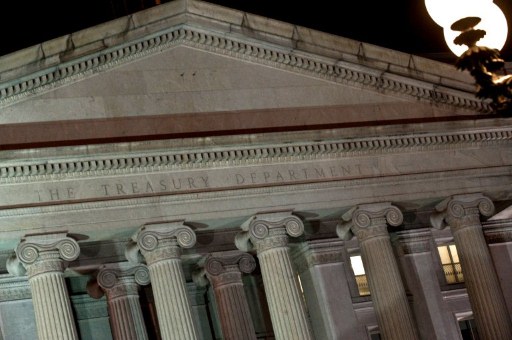
STILL INVESTMENT GRADE The facade of the US Treasury Department is seen on August 5, 2011, after Standard & Poor's cut the US credit rating from its top-flight triple-A one notch to AA+, and added a negative outlook to it. In reaction to the credit downgrade, the Bangko Sentral ng Pilipinas said a Double-A-plus rating was still investment grade and US treasuries remained to be instruments that the Philippines could invest in. AFP Photo/NICHOLAS KAMM
The Philippines will keep its holdings of US treasuries, which make up the bulk of the country’s foreign exchange reserves, even with the downgrading of the Triple-A credit rating of the United States.
In reaction to the credit downgrade by ratings firm Standard & Poor’s, the Bangko Sentral ng Pilipinas said a Double-A-plus rating was still investment grade and US treasuries remained to be instruments that the Philippines could invest in.
The BSP puts the bulk of its $69 billion worth of foreign exchange reserves in US treasuries. Under the investment guidelines of the BSP, the foreign exchange reserves should be invested only in investment grade and highly liquid instruments.
“For the BSP, US treasuries will continue to be within the allowable investible universe for our reserves even with the one-notch downgrade by S&P,” BSP Governor Amando Tetangco Jr. told reporters.
Tetangco said that even with the US credit downgrade, holding on to US treasuries remained prudent since these instruments were still the most liquid and since the value of European assets have been put at risk by the debt woes in the euro zone.
“Because the US market remains the most liquid and deepest and as Europe still faces uncertainty, the US market is not likely going to experience a huge selloff even with the one-notch downgrade. Many still see the US treasury market as a safe haven,” Tetangco said.
Still, the BSP chief said the country has over the years been diversifying its foreign exchange reserves. A small portion of the reserves is invested in other foreign, liquid assets.
“Dips in the value of US treasuries would be compensated for by earlier diversification moves,” Tetangco said.
But although the BSP is poised to continue holding on to US treasuries, Tetangco said it was prudent to pursue actions that would help shield the Philippines from uncertainties in the global economy that might result from the US credit downgrade.
Economists believed that the downgrade of the US credit rating could dampen the outlook on the performance of the global economy and thus drag the overall investment appetite of investors.
Tetangco said the Philippine government’s goal of gradually reducing its budget deficit should help keep confidence of foreign investors in the country’s sovereign bonds.
“It would be good to heed calls for improvements of fiscal management. The call by President Aquino to keep our fiscal house in order is most opportune,” Tetangco said.
Meantime, although the BSP is poised to hold on to US treasuries, Finance Secretary Cesar Purisima said it would be wise to start considering further diversification of the foreign exchange reserves of the Philippines. Purisima added that the same proposal should be considered by policymakers of other countries.
“This development [downgrade of the US credit rating] highlights the need for alternative global reserve currencies and benchmarks that are more stable and as liquid and convertible,” Purisima, who sits in the Monetary Board of the BSP, said in a statement.